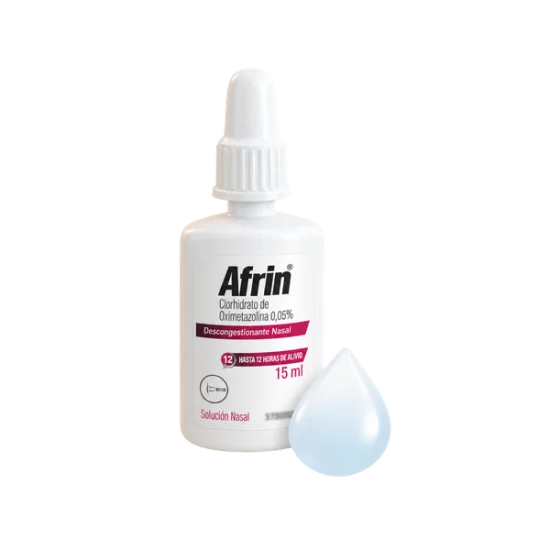
The blocked feeling eased quickly and I slept better that night. I used it for three days as advised, but my nose felt dry afterwards, so I switched to saline for comfort.
Afrin contains oxymetazoline, a nasal decongestant that narrows swollen blood vessels inside the nose. It is intended for short-term relief of blockage linked to colds, allergies or sinus congestion.
About this product
Afrin is a topical nasal decongestant containing oxymetazoline hydrochloride. It helps open a blocked nose by reducing swelling in the nasal mucosa, the moist lining inside the nasal passages. The product is supplied as a nasal sprayer for administration into the nose.
Oxymetazoline belongs to a group called alpha-adrenergic agonists.
Uses
Afrin is most suitable when swollen nasal tissue is the main reason for difficult nasal breathing. A cold can cause this through inflammation and increased blood flow. Allergic rhinitis can produce a similar blockage, often alongside sneezing, itching and watery discharge.
Sinus symptoms require more care. Afrin may temporarily open the nose during sinus congestion, yet it does not treat bacterial infection, persistent inflammation or a structural blockage. Severe facial pain, high fever, worsening symptoms or prolonged illness needs medical assessment rather than repeated decongestant use.
The following pattern helps separate short-term symptom relief from situations needing review:
- Blocked nose during a cold: temporary opening of the nasal passages may be useful.
- Allergic rhinitis: Afrin may relieve blockage briefly, but longer-term control usually requires an allergy-focused approach.
- Sinus pressure with mild congestion: short relief may help comfort, while persistent or severe symptoms need assessment.
- Post-nasal drip: improvement is possible when blockage and nasal swelling decrease, but the underlying cause remains untreated.
- Breathing difficulty from the chest or throat: Afrin is not the appropriate treatment.
Pharmacological action
Oxymetazoline stimulates alpha receptors in the blood vessels of the nasal mucosa. This produces local vasoconstriction, meaning the small vessels become narrower. Swollen tissue takes up less space, allowing air to pass more freely through the nasal passages. The response can be useful when blockage is driven by mucosal swelling. It does not remove mucus or correct a structural obstruction.
The action is local, but local treatment does not mean zero systemic exposure. A small amount can be absorbed through the nasal lining, especially when the product is used too often, applied excessively or used on irritated tissue. That explains why palpitations, headache or raised blood pressure can occur in susceptible people.
Afrin works differently from an intranasal corticosteroid. A decongestant narrows swollen vessels rapidly, while a corticosteroid reduces allergic inflammation over a slower period. The World Health Organization (WHO) distinguishes symptom-relief medicines from treatments directed at the underlying inflammatory process [1].
When not to use it
Afrin is not suitable for everyone. This medication is not for you without individual medical advice if you have any of the following:
- Uncontrolled hypertension
- Heart disease or an abnormal heart rhythm
- Hyperthyroidism
- Diabetes
- Glaucoma, especially angle-closure glaucoma
- Difficulty passing urine or an enlarged prostate
- A history of troublesome reactions to decongestants
- Pregnancy or breastfeeding
- An age below the product’s permitted range
Oxymetazoline may interact with medicines that affect sympathetic activity or blood pressure. Important groups include:
- Monoamine oxidase inhibitors
- Tricyclic antidepressants
- Other sympathomimetic decongestants
- Some antihypertensive medicines
- Combination cold and flu products containing another decongestant
When this is not for you
People with cardiovascular disease may experience a stronger response to oxymetazoline because alpha-receptor stimulation can affect blood vessels beyond the nose. Diabetes and hyperthyroidism can also increase concern about sympathomimetic effects.
Pregnancy and breastfeeding require an individual decision based on symptoms, treatment duration and medical history. Children should not receive an adult-strength product simply because the nose is blocked. Parents need advice on the exact paediatric formulation, age range and application schedule.
Adverse reactions
Afrin may cause local nasal irritation, burning, dryness or sneezing. These effects are often linked to the nasal lining becoming irritated by the spray or by repeated use. A small amount of blood on blowing the nose can occur when dry tissue is disturbed.
Possible systemic effects include headache, palpitations and increased blood pressure. They are more relevant for people with hypertension, heart disease, thyroid disease or sensitivity to sympathomimetic medicines. The FDA product label describes oxymetazoline as a nasal decongestant requiring attention to local and cardiovascular tolerability [2].
Stop using the product and obtain prompt medical advice if there is:
- Severe or persistent nasal bleeding
- Marked palpitations or an irregular heartbeat
- Chest discomfort
- Severe headache with visual symptoms
- Faintness or unusual weakness
- Breathing difficulty
- Facial swelling or another sign of a serious allergic reaction
Dryness can make the nose feel more obstructed, even when the underlying swelling is improving. Avoid inserting tissues, cotton buds or other objects deeply into the nostril, because this can worsen irritation and bleeding.
What it contains
Active Ingredient and Pharmacological Class
The active substance is oxymetazoline hydrochloride, a locally acting sympathomimetic decongestant. A small proportion may pass into the bloodstream, so the medicine can matter beyond the nose in people with cardiovascular or other medical conditions.
The exact dose, age range and frequency depend on the formulation supplied. Use the prescribed or pharmacist-agreed amount for the intended purpose rather than increasing applications when congestion returns.
Dosage and administration
The amount and frequency depend on the purpose of use and are agreed with a doctor or pharmacist. Strength, age limits and permitted frequency vary between oxymetazoline products, so a universal numerical dose would be unsafe.
Use the sprayer through the nose. Practical administration usually involves these steps:
- Clear the nose gently before use.
- Keep the sprayer upright.
- Place the nozzle just inside the nostril without pushing it deeply.
- Direct the spray away from the nasal septum, the central wall between the nostrils.
- Breathe in gently during application.
- Wipe the nozzle after use and replace its protective cover.
- Use the lowest effective amount for the shortest suitable period.
A typical short-course principle is no more than three days unless a clinician gives different instructions for the specific product. Children need special care because age limits and strengths differ. A child should receive only the formulation and dosing schedule specifically intended for that age group.
Missed applications do not usually require a replacement double dose. Resume the agreed schedule when the next application is due. Extra sprays increase exposure without reliably producing better airflow.
Comparison
Different nasal treatments suit different causes of blockage.
| Treatment category | Main action and limitation |
|---|---|
| Afrin with oxymetazoline | Rapid local reduction of nasal swelling; intended for short-term use because of rebound congestion risk |
| Saline nasal spray | Moistens and clears mucus; can be used without decongestant rebound, though it may feel less powerful |
| Intranasal corticosteroid or antihistamine spray | Targets allergic inflammation or allergy symptoms; full benefit may take longer and the correct product depends on the symptom pattern |
Afrin may provide faster short-term relief than saline, while saline can help loosen mucus and support nasal comfort without stimulating alpha receptors. Intranasal corticosteroids are more relevant when persistent allergic inflammation drives blockage. Antihistamine nasal sprays may help when sneezing, itching and watery discharge are prominent.
Oral decongestants work throughout the body and may carry greater cardiovascular relevance for some patients. Afrin acts mainly in the nose, yet its local route does not remove all interaction or blood-pressure concerns. Choice should reflect the cause, duration and medical history rather than speed alone.
Common mistakes
Common mistakes include:
- Using Afrin for longer than the agreed short course
- Spraying towards the nasal septum
- Pushing the nozzle deeply into the nostril
- Applying more sprays because the first dose seems less helpful
- Combining Afrin with another decongestant
- Sharing the sprayer
- Rinsing or altering the device in a way not permitted for that product
- Using an expired nasal medicine
- Treating severe facial pain or fever as a simple blocked nose
- Assuming that a returning blocked nose proves a stronger dose is needed
A shared sprayer can transfer respiratory organisms between people. Each person should have a separate device. The nozzle should be kept clean by wiping it appropriately, without inserting sharp objects into the opening or immersing the device unless the product instructions specifically allow that handling.
Incorrect technique can leave much of the medicine at the front of the nostril, where it may cause irritation without reaching the swollen area effectively. Gentle inhalation is preferable to a forceful sniff, which can send liquid into the throat and create an unpleasant taste.
What doctors say
Clinically, Afrin may provide short-term relief when swollen nasal tissue is causing blockage. Use it consistently as directed by a doctor or pharmacist, since strength, age limits and frequency vary. Seek medical advice for severe facial pain, high fever, worsening symptoms or prolonged illness.
Questions and answers
What condition rules out Afrin without individual medical advice?
Uncontrolled hypertension is a condition that requires individual advice before using oxymetazoline. Alpha-receptor stimulation can narrow blood vessels and may raise cardiovascular concerns in susceptible people. NHS decongestant guidance published in 2024 supports checking decongestant suitability in people with cardiovascular risk factors before use.
How soon can Afrin’s effect become noticeable?
Oxymetazoline is designed to reduce nasal swelling relatively quickly after nasal administration. The exact onset varies with the degree of blockage, nasal irritation and the formulation used, so a precise time should not be treated as a guarantee. NHS decongestant guidance reviewed in 2024 describes topical nasal decongestants as short-term symptom-relief products rather than treatments for the underlying cold or allergy.
How long can a course last, and is long-term use acceptable?
Afrin is generally intended for a short course, commonly no more than three days unless a clinician directs otherwise. Longer or repeated use can cause rhinitis medicamentosa, with congestion becoming worse after the effect fades. The FDA product label dated 2024 directs users to follow the specified duration and warns against prolonged use that can worsen congestion.
Can Afrin affect driving, concentration or work with machinery?
Afrin does not usually function as a sedative, so many people remain alert during use. Headache, palpitations, dizziness or blurred vision can affect safe driving or machinery work if they occur. NHS medicines information published in 2024 advises stopping an activity that requires full concentration until such symptoms have settled and obtaining medical advice when they are pronounced.
What should happen if the expected result does not come?
Do not keep increasing the frequency or amount. Confirm that the main problem is nasal blockage rather than severe sinus disease, chest breathing difficulty or another condition, then obtain advice from a pharmacist or general practitioner. The FDA product label dated 2024 supports reassessment when a short-term medicine does not provide the expected symptom relief or when symptoms persist.
Which diet, exercise or habits can help or hinder the result?
Avoid cigarette smoke, vaping aerosols and heavily polluted air because they can irritate the nasal lining and worsen blockage. Gentle hydration and saline nasal care may improve comfort, while strenuous activity should be avoided if congestion accompanies fever, chest symptoms or significant illness. No food is known to make oxymetazoline work better, and the FDA product label dated 2024 identifies duplicate decongestant use as more relevant to safety than diet or exercise.
Do you offer anonymous delivery?
Your order will be securely packed and shipped within 24 hours. This is exactly what your package will look like (images of an actual item sent). It has the size and look of a regular private letter (24x11x0.7 cm) and its contents cannot be seen.
Clinical Guidance and When to Seek Help
A pharmacist or general practitioner should assess persistent nasal congestion that continues after the recommended short course. Recurrent nosebleeds, severe headache, marked facial pain, high fever, vision symptoms or steadily worsening illness also need clinical review.
Urgent medical attention is appropriate for sudden breathing difficulty, severe palpitations, chest pain, fainting or swelling of the face and throat. These symptoms may indicate a problem that Afrin cannot treat.
For long-term allergy symptoms, a pharmacist may help identify a non-decongestant option, such as saline care, an antihistamine approach or an intranasal corticosteroid. The best choice depends on whether the main problem is blockage, sneezing, itching, watery discharge or persistent inflammation.
In clinical practice, the most common avoidable problem is not a single incorrect application. It is continuing the product after the original cold should have settled, then mistaking rebound congestion for a new infection.
Afrin: What Customers Say
The first day was helpful, especially before bed. By the fourth day I was reaching for it more often because the blockage returned, and I later learned that this could be rebound congestion.
It opened one side of my nose within a short time, but it did not resolve the facial pressure. The pressure and fever continued, so I arranged a medical assessment rather than continuing the spray.
Sources
- World Health Organization (2023). WHO Model List of Essential Medicines, 23rd list.
- FDA (2024). Drug Facts label — oxymetazoline hydrochloride nasal spray.