The hot flushes were annoying during the first cycle, and I felt more emotional than usual. The scan helped me understand what was happening, and the second cycle felt easier to manage.
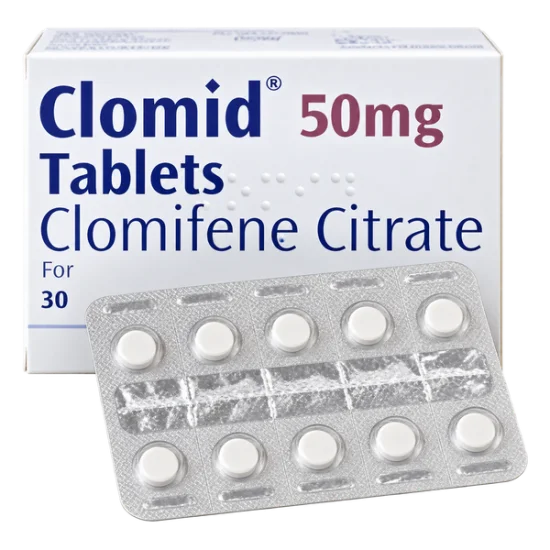
Clomifene citrate, the active ingredient of Clomid, is an oral selective oestrogen receptor modulator used to stimulate ovulation. It is prescribed for women who ovulate infrequently or not at all, including some women with polycystic ovary syndrome. By altering oestrogen feedback to the brain, Clomid encourages the release of hormones that support follicle growth and egg release.
About this product
Clomid contains clomifene citrate, also called clomiphene citrate in international medical literature. It belongs to the selective oestrogen receptor modulator class, or SERM.
Uses
Anovulatory infertility means that ovulation does not occur. Oligo-ovulatory infertility means that ovulation occurs irregularly or less often than expected. Both patterns can reduce the opportunity for fertilisation because an egg is released infrequently or unpredictably.
Clomid may be used when infertility is linked to these ovulatory problems. A common underlying condition is polycystic ovary syndrome, or PCOS. PCOS can disturb follicle development and cause anovulation, although not every person with PCOS has the same hormone pattern or fertility needs.
Assessment before treatment may include:
- Menstrual history and ovulation pattern.
- Pregnancy testing where appropriate.
- Thyroid and prolactin testing when clinically indicated.
- Ovarian reserve assessment.
- Semen analysis for the partner.
- Evaluation of fallopian tube patency when indicated.
- Ultrasound assessment of the ovaries and uterine lining.
The goal is not simply to produce as many follicles as possible. The clinical aim is to achieve ovulation while limiting the risk of excessive ovarian response and multiple pregnancy.
Management of PCOS-related anovulation
Clomid has been used for PCOS-related ovulation induction for many years. NICE fertility guidance describes oral ovulation-induction treatment as part of a structured approach for people with anovulatory infertility, with treatment choice influenced by the cause of anovulation and individual factors [3].
Weight, insulin resistance, thyroid disease, sleep, and menstrual regularity can influence fertility in PCOS. These factors do not make Clomid unsuitable by themselves, but they can affect the treatment plan and the likelihood of ovulation.
Pharmacological action
Clomid acts mainly through the hypothalamus and pituitary gland. These structures regulate the release of reproductive hormones. Clomifene reduces oestrogen feedback at the hypothalamus, which can increase gonadotrophin-releasing hormone signalling.
The pituitary gland may then release more follicle-stimulating hormone, known as FSH, and luteinising hormone, known as LH. FSH supports the growth of ovarian follicles. LH contributes to final follicle maturation and the hormonal surge associated with ovulation.
The process can be summarised as follows:
- Clomifene interacts with oestrogen receptors in the hypothalamus.
- The hypothalamus increases reproductive hormone signalling.
- The pituitary gland releases FSH and LH.
- FSH encourages follicle development in the ovary.
- LH supports maturation and ovulation.
- A mature follicle may release an egg for possible fertilisation.
The mechanism explains both the benefit and some limitations of Clomid. It depends on the ovaries being capable of responding and on the hypothalamus and pituitary gland producing an appropriate hormonal response. The medicine cannot correct blocked fallopian tubes, severe male-factor infertility, or every cause of reduced fertility.
The FDA prescribing information describes clomifene as a non-steroidal ovulatory stimulant that acts through the hypothalamic–pituitary–ovarian system [2].
When not to use it
Clomid is not suitable for everyone. This treatment is not for you if you have any of the following:
- Pregnancy.
- Unexplained abnormal uterine bleeding.
- Ovarian cysts unrelated to PCOS.
- Uncontrolled thyroid or adrenal disease.
- Severe liver disease or a history of significant liver dysfunction linked to treatment.
- Previous or current liver tumours.
- Uncontrolled pituitary or hypothalamic disease.
- A known allergy to clomifene or an excipient in the tablet.
- Ovarian failure where ovarian stimulation is not expected to work.
- Visual symptoms that began during earlier clomifene treatment.
There is no single interaction list that replaces a medication review. Tell the prescribing clinician about fertility medicines, hormone treatments, medicines for thyroid disease, liver disease, epilepsy, diabetes, or psychiatric conditions. The full medication history also includes vitamins, herbal products, and non-prescription treatments.
When this is not for you
Clomid is not appropriate for every fertility problem. It cannot restore ovulation when ovarian failure is the main cause, and it does not open blocked fallopian tubes.
Clomid should not be started while pregnancy is possible in the current cycle. Pregnancy testing and cycle timing are important because treatment is intended to induce ovulation, not to continue during pregnancy.
Clomid can increase the chance of multiple pregnancy. A pregnancy involving twins or more carries higher obstetric risks, so ultrasound monitoring may be recommended when several follicles develop. Monitoring may help identify an excessive ovarian response before complications develop. The prescribing team can explain which symptoms require urgent assessment. Decisions about further cycles should take the scan findings and treatment response into account.
Adverse reactions
The most frequently discussed effects include hot flushes, headache, nausea, breast discomfort, abdominal or pelvic discomfort, mood changes, and changes in cervical mucus. Some people experience blurred vision or flashes of light. Visual symptoms require prompt medical attention because continued treatment may increase the risk of persistent visual disturbance.
Clomid can also enlarge the ovaries. Ovarian enlargement may cause pelvic pressure, bloating, or cramping. Severe pelvic pain, rapidly increasing abdominal swelling, breathlessness, faintness, or a sudden increase in body weight may indicate a serious ovarian response and require urgent assessment.
| Side-effect pattern | Examples and clinical meaning |
|---|---|
| Common or short-lived | Hot flushes, headache, nausea, breast tenderness, mood changes, abdominal discomfort |
| Treatment-limiting | Marked pelvic pain, troublesome mood symptoms, visual blurring or flashing lights |
| Urgent symptoms | Severe abdominal swelling, intense pelvic pain, breathlessness, fainting, or symptoms suggesting ovarian hyperstimulation |
Ovarian hyperstimulation syndrome is more commonly associated with injectable gonadotrophins, yet ovarian enlargement and excessive response remain relevant risks with ovulation-induction treatment. Multiple pregnancy is also possible because more than one follicle may mature.
The FDA label identifies visual symptoms, ovarian enlargement, abdominal discomfort, nausea, hot flushes, and multiple pregnancy among clinically relevant risks of clomifene treatment [5].
Some people notice that cervical mucus becomes less favourable for sperm movement. The anti-oestrogen effect that supports pituitary stimulation can also reduce cervical mucus or affect the uterine lining in some treatment cycles.
One practical detail is easy to miss: pelvic discomfort after ovulation may be mild, but pain that becomes severe, one-sided, or associated with vomiting is not a routine nuisance to manage at home.

What it contains
Clomid contains clomifene citrate, also known as clomiphene citrate in international medical literature. It belongs to the selective oestrogen receptor modulator (SERM) class and is supplied as oral tablets.
Dosage and administration
A treatment cycle requires clinical timing. Ovulation tests, ultrasound scans, blood tests, or a combination of these methods may be used to assess the response.
The treatment sequence usually involves:
- Choosing a cycle day for starting tablets.
- Monitoring follicle development or ovulation.
- Timing intercourse or IUI around the expected fertile period.
- Confirming ovulation when clinically appropriate.
- Reviewing the response before another cycle.
If a dose is missed, do not automatically double the next dose. The correct action depends on the treatment purpose, cycle day, and prescribed schedule; contact the prescribing doctor or pharmacist promptly for an individual instruction.
Clomid tablets should be swallowed as directed. Do not crush or chew them unless a prescriber or pharmacist has specifically authorised that method, because altering a tablet can affect how it is taken and make accurate dosing more difficult.
The UK product information describes clomifene as a treatment that stimulates ovulation through effects on the hypothalamic–pituitary–ovarian axis [1].
Comparison
Letrozole is a pharmacological alternative used in some ovulation-induction protocols. It inhibits aromatase, the enzyme involved in oestrogen production. Lower oestrogen production changes feedback to the hypothalamus and pituitary, encouraging the release of FSH.
Clomid and letrozole therefore stimulate ovulation through different mechanisms:
- Clomid mainly blocks oestrogen receptor signalling in the hypothalamus.
- Letrozole reduces oestrogen synthesis through aromatase inhibition.
- Clomid may have anti-oestrogen effects on cervical mucus and the uterine lining.
- Letrozole may have a shorter anti-oestrogen effect outside the brain.
Letrozole is often considered for PCOS-related anovulation when Clomid has not produced ovulation or has caused an unsuitable response. The choice depends on clinical history, local guidance, pregnancy plans, monitoring access, and previous treatment response.
| Treatment approach | Main pharmacological or clinical role |
|---|---|
| Clomid | Oral stimulation of the body’s own FSH and LH release |
| Injectable fertility medicines | Direct hormonal stimulation of follicle development |
| IVF | Egg collection, laboratory fertilisation, and embryo transfer |
The European Society of Human Reproduction and Embryology and the American Society for Reproductive Medicine both emphasise individualised treatment selection for anovulatory infertility rather than using one protocol for every patient [4].
Common mistakes
Several avoidable errors can make a treatment cycle harder to assess:
- Starting tablets on the wrong cycle day.
- Taking an extra tablet after a missed dose without specific instructions.
- Continuing treatment despite visual disturbance.
- Assuming a regular bleed proves that ovulation occurred.
- Missing an ultrasound or blood test used to time ovulation.
- Ignoring severe pelvic pain because mild cramping is expected.
- Taking Clomid without assessing other infertility factors.
- Treating the product as a general testosterone booster rather than an ovulation-induction medicine.
- Failing to report liver disease, ovarian cysts, or current pregnancy risk.
What doctors say
In clinical practice, doctors usually set a defined treatment plan rather than allowing Clomid to continue indefinitely without review. The response is assessed through menstrual timing, ovulation testing, ultrasound, or blood hormone measurement.
A fertility specialist may also investigate the partner’s semen, tubal patency, ovarian reserve, thyroid function, and prolactin. Treating ovulation alone cannot overcome every cause of infertility.
Doctors also watch for an excessive ovarian response. A stronger response is not automatically a better response because it can increase the chance of ovarian complications and multiple pregnancy. Visual symptoms, severe pelvic pain, and marked abdominal swelling deserve rapid clinical review.
The MHRA and EMA product information support limiting treatment duration and monitoring the response because repeated or prolonged exposure may increase certain ovarian risks.
Questions and answers
Can Clomid tablets be split, crushed, or chewed?
Clomid tablets should generally be swallowed whole with water unless a prescriber or pharmacist gives different instructions. The MHRA product information available in 2024 supports taking clomifene according to the prescribed schedule and avoiding unsupervised changes to the tablet. Splitting can make the dose less reliable, while crushing or chewing is unnecessary for a standard tablet. Visual symptoms after taking the medicine require prompt medical assessment.
How does Clomid differ from letrozole?
Clomid blocks oestrogen receptor signalling in the hypothalamus, while letrozole inhibits aromatase and reduces oestrogen production. NICE guidance from 2023 recognises that different oral ovulation-induction strategies may be considered according to the cause of anovulation and treatment history. Clomid can affect cervical mucus and the uterine lining because of its anti-oestrogen activity. Letrozole is frequently discussed for PCOS-related anovulation when a different mechanism is preferred.
What is the best time of day to take Clomid?
There is no universal morning or evening time that suits every Clomid treatment plan. The MHRA product information from 2024 places greater emphasis on the prescribed cycle days and consistent dosing than on a particular clock time. If tablets are taken daily during a course, taking them at the same time helps prevent missed doses. A person who forgets a dose should obtain specific instructions rather than doubling the next dose.
Can Clomid affect driving, concentration, or work with machinery?
Clomid may cause headache, dizziness, visual blurring, flashes, or difficulty focusing. The MHRA medicine safety information from 2024 means that driving, operating machinery, or working at height should stop if vision becomes abnormal or concentration is impaired. These effects may appear during a treatment cycle even when earlier doses caused no problem. Persistent or worsening visual symptoms require urgent medical advice.
Do diet, exercise, or daily habits affect the result?
The WHO infertility guidance published in 2023 supports addressing general health factors alongside treatment, while recognising that lifestyle measures cannot replace ovulation induction when medication is indicated. A balanced diet, regular moderate activity, adequate sleep, and avoidance of smoking can support reproductive health. Very restrictive dieting, excessive exercise, heavy alcohol use, and untreated metabolic disease may hinder fertility. PCOS-related insulin resistance, thyroid disease, and weight changes should be discussed as part of the treatment plan.
Do you offer anonymous delivery?
Your order will be securely packed and shipped within 24 hours. This is exactly what your package will look like (images of an actual item sent). It has the size and look of a regular private letter (24x11x0.7 cm) and its contents cannot be seen.
Clomid: What Customers Say
My periods had been unpredictable for months. I had mild cramping and headaches, but the main difficulty was arranging appointments around work. The monitoring showed that I had responded.
I did not notice much during the first week, then had pelvic discomfort around the expected ovulation time. The cycle did not lead to pregnancy, so the clinic reviewed other factors instead of simply repeating it.
The instructions were straightforward once the cycle dates were written down. I experienced hot flushes at night and found sleep more difficult, but the clinic adjusted the timing after reviewing the scan.
I noticed flashing lights and blurred vision during treatment. I stopped taking further tablets and contacted the fertility team the same day. The symptom was taken seriously, which was reassuring.
Sources
- MHRA (2024). Clomifene citrate: Summary of Product Characteristics.
- FDA (2012). Clomid (clomiphene citrate) Tablets: Prescribing Information.
- NICE (2023). Fertility problems: assessment and treatment.
- European Society of Human Reproduction and Embryology (2023). Evidence-based guideline: prevention, diagnosis and treatment of infertility.
- FDA (2012). Clomid (clomiphene citrate) Tablets: Adverse Reactions and Warnings.