My pressure readings improved at the follow-up appointment. The first week brought a bitter taste and mild stinging, but pressing the corner of my eye helped. I still found the evening dose easy to forget when working late.
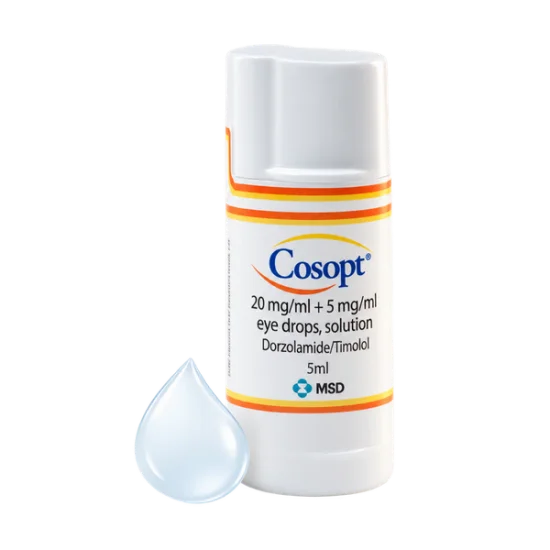
Cosopt is a prescription ophthalmic solution containing dorzolamide hydrochloride and timolol maleate, used for ocular hypertension and open-angle glaucoma. Its combined action reduces aqueous humour production and helps lower intraocular pressure. [1]
About this product
Raised pressure inside the eye can damage the optic nerve gradually, often without early pain or obvious vision changes.
Cosopt is supplied as eye drops in a bottle. The amount used at each administration is set individually for each person rather than being one fixed amount. It belongs to two pharmacological groups:
- Dorzolamide: a topical carbonic anhydrase inhibitor.
- Timolol: a topical beta-adrenoceptor blocker.
- Combined treatment: a fixed ophthalmic combination that reduces fluid formation through two separate pathways.
Uses
The main clinical purpose is pressure control. Lowering intraocular pressure can reduce the risk of further optic-nerve injury in people with open-angle glaucoma or ocular hypertension.
Cosopt is used in chronic eye-care plans. It does not restore optic-nerve tissue already lost through glaucoma, and it does not remove the need for pressure checks, visual-field testing, or optic-disc assessment.
Primary clinical indications
Cosopt may be prescribed when one pressure-lowering medicine does not provide sufficient control, or when a clinician considers a fixed combination suitable. The treatment target is intraocular pressure, not blurred vision alone.
Open-angle glaucoma often develops slowly. Ocular hypertension means pressure is higher than the usual range without definite glaucomatous optic-nerve damage. Some people with ocular hypertension receive treatment because their calculated risk of future glaucoma is significant.
Pharmacological action
Aqueous humour is the clear fluid produced inside the front part of the eye. It nourishes nearby structures and normally drains through the eye’s outflow pathways. When production exceeds drainage, intraocular pressure may rise.
Dorzolamide and timolol reduce aqueous humour production by different mechanisms. The combination therefore targets two control points rather than relying on one pharmacological effect.
| Component | Pharmacological action | Result in the eye |
|---|---|---|
| Dorzolamide hydrochloride | Inhibits carbonic anhydrase II | Less bicarbonate formation and reduced aqueous humour secretion |
| Timolol maleate | Blocks beta-adrenergic stimulation | Reduced aqueous humour production by the ciliary body |
Dorzolamide hydrochloride
Carbonic anhydrase is an enzyme involved in bicarbonate formation. Bicarbonate contributes to ion movement and fluid secretion within the ciliary processes, the tissues that produce aqueous humour.
Dorzolamide inhibits carbonic anhydrase locally after application to the eye. This reduces the movement of sodium and fluid into the anterior chamber. Its action is directed at production rather than increasing drainage.
Dorzolamide can still be absorbed systemically. People with severe kidney impairment may need a different treatment because dorzolamide and its metabolite are eliminated through the kidneys.
Timolol maleate
Timolol blocks beta receptors in the ciliary body. This reduces the stimulatory effect of catecholamines on aqueous humour formation.
Timolol is not limited to the eye. A small amount may pass through the nasal mucosa into the bloodstream, especially when excess solution drains through the tear duct. Systemic absorption explains warnings involving asthma, slow pulse, heart block, and some forms of heart failure.
The two ingredients can lower pressure more than either component alone. Their combined use also means that contraindications from both drug classes need to be considered.
When not to use it
Cosopt is not for you if you have:
- Bronchial asthma or a history of severe asthma.
- Severe chronic obstructive airway disease with bronchospasm.
- Sinus bradycardia.
- Second- or third-degree atrioventricular block without a functioning pacemaker.
- Overt cardiac failure or cardiogenic shock.
- Severe renal impairment or hyperchloraemic acidosis related to dorzolamide.
- A previous serious allergic reaction to dorzolamide, timolol, or a related sulfonamide medicine.
Important interactions include:
- Oral beta-blockers or other topical beta-blockers may intensify slow pulse and low blood pressure.
- Verapamil, diltiazem, and other medicines that slow cardiac conduction may increase the risk of bradycardia or heart block.
- Digoxin can add to effects on cardiac conduction.
- Medicines that reduce blood pressure may increase dizziness or hypotension.
- Quinidine and some medicines that inhibit CYP2D6 may increase systemic beta-blocker effects.
- Other carbonic anhydrase inhibitors may increase the risk of additive adverse effects.
- Adrenaline-containing treatment requires clinical caution because beta-blockade can alter cardiovascular responses.
When this is not for you
Cosopt is not suitable for everyone. The timolol component can affect the airways, heart rate, and cardiac conduction, while dorzolamide requires caution when renal elimination is impaired.
Tell the prescriber about all eye drops, tablets, inhalers, and heart medicines.
Before surgery, tell the anaesthetist that you use an ophthalmic beta-blocker. Timolol can influence the response to anaesthetic medicines and medicines used during procedures.
Pregnancy and breastfeeding require an individual risk assessment. The MHRA advises that systemic exposure can occur with ophthalmic beta-blockers, so the decision should consider the eye-pressure risk and possible effects on the mother or infant.
Adverse reactions
Temporary burning, stinging, blurred vision, tearing, or a foreign-body sensation can occur after application. These effects often settle quickly, but persistent discomfort, marked redness, eyelid swelling, or worsening vision requires prompt clinical assessment.
Reported ocular effects include:
- Irritation or burning after instillation.
- Dry eyes or increased tearing.
- Eyelid inflammation.
- Conjunctival redness.
- Corneal sensitivity or reduced corneal sensation.
- Taste disturbance caused by drainage through the tear duct.
- Blurred vision immediately after application.
Dorzolamide may cause a bitter taste. Nasolacrimal occlusion can reduce this sensation because less solution reaches the throat.
Timolol may cause systemic beta-blocker effects. These can include a slow pulse, low blood pressure, dizziness, fatigue, shortness of breath, wheezing, or cold hands and feet. Severe breathing difficulty, fainting, chest discomfort, or a very slow heartbeat needs urgent medical attention.
A preservative-containing eye drop may aggravate an already sensitive ocular surface. People with dry eye, blepharitis, or frequent daily eye-drop use can experience more irritation over time.
One detail patients often miss is that blurred vision immediately after a drop does not mean the medicine has failed. The solution can temporarily disturb the tear film. Driving should wait until vision is clear.
Another practical issue is taste. A bitter or medicinal taste several minutes after administration can result from tear-duct drainage, not necessarily from a stomach problem.
What it contains
Cosopt is supplied as eye drops in a bottle. The amount used at each administration is set individually for each person rather than being one fixed amount. It belongs to two pharmacological groups:
- Dorzolamide: a topical carbonic anhydrase inhibitor.
- Timolol: a topical beta-adrenoceptor blocker.
- Combined treatment: a fixed ophthalmic combination that reduces fluid formation through two separate pathways.
Dosage and administration
The amount used per administration is set individually. Prescribing depends on the eye-pressure target, previous glaucoma treatment, response, kidney function, and other medicines.
Use Cosopt by the ophthalmic route only. The usual administration pattern is one drop in the affected eye or eyes twice daily when prescribed as a fixed combination, but the prescriber’s individual regimen takes priority.
Practical administration points include:
- Wash and dry the hands before use.
- Tilt the head back and pull the lower eyelid down gently.
- Place the prescribed drop into the pocket between the eyelid and eye.
- Do not allow the bottle tip to touch the eye, lashes, eyelids, or fingers.
- Close the eye gently after application.
- Apply pressure to the inner corner of the closed eye for around two minutes.
- Leave at least ten minutes between Cosopt and another ophthalmic drop unless the prescriber gives different instructions.
- Remove contact lenses before administration if the formulation contains a preservative, then wait at least fifteen minutes before replacing them.
If a dose is missed, use it when remembered unless the next scheduled dose is close. In that situation, skip the missed dose and continue with the normal schedule. Do not apply two doses together.
Do not increase the number of drops to speed up pressure reduction. Extra solution increases exposure without producing a proportionate benefit and can increase local irritation or systemic beta-blocker effects.
A useful practical distinction is that eye drops are not measured like oral liquid medicines. One drop is the administration unit, and placing several drops into the same eye does not create a more reliable treatment effect.
Comparison
Treatment choices for glaucoma are selected by mechanism, pressure response, eye condition, medical history, and tolerability. A fixed dorzolamide–timolol combination can reduce the number of separate bottles compared with using the two ingredients independently.
| Treatment approach | Main characteristic | Practical limitation |
|---|---|---|
| Fixed dorzolamide–timolol combination | Two pressure-lowering mechanisms in one ophthalmic solution | Carries precautions from both ingredients |
| Separate dorzolamide and timolol drops | Individual adjustment of each medicine | More administration steps and greater scheduling complexity |
| Single-agent pressure-lowering drop | One active mechanism | May not lower pressure enough for the treatment target |
A switch between products with similar active ingredients still requires a clinical decision. Concentrations, preservatives, bottle design, dosing schedules, and licensed indications can differ even when the pharmacological classes appear similar.
Prescribers may choose a single agent if asthma, bradycardia, heart block, kidney disease, ocular-surface sensitivity, or another contraindication makes one component unsuitable. A separate-drop regimen can also be useful when the clinician wants to adjust one active ingredient without changing the other.
The National Institute for Health and Care Excellence glaucoma guidance supports treatment decisions based on intraocular pressure, optic-nerve findings, visual-field changes, and the person’s risk profile rather than pressure alone. [4]
Common mistakes
Several administration errors can reduce the amount of medicine reaching the eye or increase unwanted absorption.
- Touching the bottle tip to the eye or lashes.
- Squeezing the bottle repeatedly because the first drop was not felt.
- Applying two drops to compensate for a missed dose.
- Stopping treatment when vision appears unchanged.
- Using Cosopt immediately after another eye drop without allowing an interval.
- Forgetting to mention the medicine before surgery.
- Continuing contact-lens use despite preservative-related irritation.
- Ignoring wheezing, faintness, or an unusually slow pulse.
- Using the medicine in an eye that was not included in the prescription.
- Sharing the bottle with another person.
Many people blink hard after instillation. That can push solution out of the eye and onto the cheek. Gentle eye closure is more useful than forceful blinking.
A second common error is placing drops while lying flat. Tilting the head back while seated or standing usually gives better control and reduces accidental contact between the bottle tip and the eyelid.
Patients sometimes judge success by comfort. Glaucoma pressure can improve without a noticeable sensation, so follow-up measurements remain essential.
What doctors say
In clinical practice, glaucoma treatment is judged by measured pressure and by signs of optic-nerve stability, not by whether the eyes feel different. A person may have excellent adherence and still need a treatment change if the target pressure is not reached.
Ophthalmologists usually assess several points:
- Baseline and follow-up intraocular pressure.
- Optic-disc appearance.
- Optical coherence tomography measurements.
- Visual-field performance.
- Ocular-surface tolerability.
- Pulse, breathing symptoms, and relevant cardiovascular history.
The European Medicines Agency describes the dorzolamide–timolol combination as a pressure-lowering ophthalmic treatment for patients with open-angle glaucoma or ocular hypertension when combination therapy is appropriate. [2]
A doctor may continue Cosopt for years when it controls pressure and remains tolerable. Long-term treatment is common in glaucoma because the underlying risk usually persists even when pressure readings improve.
The most useful clinical habit is regular administration at the same two daily time points. Missing occasional doses may not produce symptoms, yet repeated omissions can allow pressure to rise without warning.
Questions and answers
Can people under 18 use Cosopt?
Cosopt is not routinely used in children and adolescents unless an ophthalmology specialist has made an individual decision. Paediatric evidence and dosing considerations differ from adult glaucoma management. The European Medicines Agency product information from 2010 describes the medicine mainly within adult treatment pathways, with paediatric use requiring specialist judgement. [3] A child with raised eye pressure needs assessment of the underlying cause, optic-nerve appearance, eye size, and developmental factors before treatment is selected.
What should be discussed with a doctor before starting Cosopt?
Tell the prescriber about asthma, chronic obstructive airway disease, slow pulse, heart block, heart failure, kidney disease, sulfonamide reactions, pregnancy, and breastfeeding. Provide a complete list of medicines, including tablets, inhalers, eye drops, and non-prescription products. The MHRA safety framework from 2017 supports checking respiratory and cardiovascular history before treatment. [5] This discussion also helps determine whether a fixed combination or separate medicines provide the most suitable pressure control.
How long does a Cosopt course last, and is long-term use acceptable?
Cosopt is often used as long-term maintenance because glaucoma and ocular hypertension can remain chronic conditions. The duration depends on pressure measurements, optic-nerve findings, visual fields, adverse effects, and whether another treatment becomes more suitable. The 2022 NICE guidance supports ongoing review rather than stopping pressure-lowering treatment solely because symptoms are absent. Long-term use is acceptable when the ophthalmology team continues to judge the benefits greater than the risks and monitors the eyes and relevant systemic effects.
Is Cosopt suitable for older adults?
Older adults may use Cosopt when the prescriber considers both eye findings and general health. Age-related kidney impairment, slow pulse, low blood pressure, heart-conduction disease, asthma, and multiple medicines can affect suitability. The WHO's 2015 World report on ageing and health supports medication review that considers functional status, comorbidity, and polypharmacy rather than age alone. Older patients should report falls, faintness, new breathlessness, confusion after administration, or a persistent slow heartbeat.
Can Cosopt cause a slow heartbeat?
Yes. Timolol can enter the bloodstream after eye-drop administration and may slow the heart rate, even though the medicine is applied to the eye. The MHRA's 2017 safety guidance recognises systemic beta-blocker effects as a relevant safety consideration for ophthalmic timolol. Contact the prescribing service promptly for fainting, severe dizziness, unusual fatigue, breathlessness, or a noticeably slow pulse; urgent assessment is needed for collapse or severe breathing difficulty.
Do you offer anonymous delivery?
Your order will be securely packed and shipped within 24 hours. This is exactly what your package will look like (images of an actual item sent). It has the size and look of a regular private letter (24x11x0.7 cm) and its contents cannot be seen.
Cosopt: What Customers Say
The drops were straightforward after I learned not to touch the bottle to my lashes. My eyes felt dry by the afternoon, so the ophthalmology team reviewed my other drops and changed the timing. The pressure control was useful, although the routine took discipline.
I noticed short-lived blurred vision after application, mostly in the morning. It cleared within minutes. I was disappointed that I could not tell whether the treatment was working, but the clinic measurements gave a clearer answer.
The burning was uncomfortable after some doses and my eyes looked red. I stopped adding extra drops and arranged a review instead. The clinician checked the surface of my eye and discussed a different option.
Sources
- U.S. Food and Drug Administration (2019). COSOPT (dorzolamide hydrochloride–timolol maleate) ophthalmic solution prescribing information.
- European Medicines Agency (2010). Cosopt: summary of product characteristics.
- European Medicines Agency (2010). Cosopt: product information for patients and healthcare professionals.
- National Institute for Health and Care Excellence (2022). Glaucoma: diagnosis and management.
- Medicines and Healthcare products Regulatory Agency (2017). Beta-blockers: reminder of risk of systemic effects when administered as eye drops.