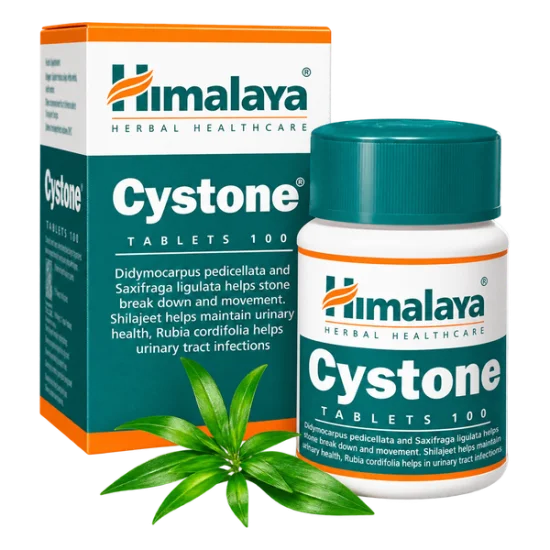
I used the tablets during a period when I was trying to improve my fluid routine. After several weeks my urinary discomfort felt less noticeable, although I still kept my planned medical checks. I found that taking them with water was easier on my stomach.
Cystone is taken as oral tablets for urinary tract support and kidney-stone care. Its polyherbal formulation is intended for adults seeking support with urinary comfort and recurrent stone-forming problems.
About this product
Cystone is a tablet-based herbal formulation from Himalaya Herbal Healthcare. It is used in urinary wellness programmes that focus on kidney-stone management, urine flow, and bladder comfort. The product is supplied as a bottle containing 100 tablets.
Uses
Cystone is used in contexts that include:
- Support during kidney-stone management.
- Maintenance of urinary flow and comfort.
- Support for people with recurring crystallisation of urinary mineral salts.
- General bladder and urinary tract wellness.
- Adjunctive care alongside fluid intake and dietary measures.
The phrase “lithotriptic support” refers to an intended role in helping reduce or manage mineral concretions. It does not mean that a tablet can safely dissolve every stone. Stone size, location, composition, kidney function, and urinary obstruction determine the appropriate treatment.
In clinical practice, people respond differently to herbal urinary products. Some report easier urinary comfort after consistent use, while others notice little change because their symptoms arise from infection, obstruction, or a stone that needs a procedure. Cystone should therefore be viewed as part of a broader urinary-care plan rather than a replacement for imaging or treatment of a trapped stone.
NICE guidance on renal and ureteric stones places fluid intake, stone analysis, and assessment of recurrence risk at the centre of care [1].
Pharmacological action
A diuretic effect means increased urine production or urinary flow. A demulcent effect refers to soothing support for irritated mucous membranes. Lithotriptic terminology describes a traditional role associated with urinary calculi; it must not be interpreted as a guarantee that an established stone will disappear.
Botanical actions in plain language
Cystone’s botanical approach is intended to combine several types of urinary support:
- Urinary-flow support: promoting regular fluid passage may help reduce stagnant urine.
- Crystallisation support: the formulation is used with hydration and dietary measures aimed at reducing conditions that favour mineral precipitation.
- Bladder comfort: soothing properties may help some people experiencing mild urinary irritation.
- Stone-care support: traditional botanical use focuses on renal calculi and urinary mineral deposits.
The WHO framework for herbal medicines stresses correct botanical identification, quality control, and assessment of the finished preparation rather than assuming that every product with a traditional name has the same composition [2].
When not to use it
- Known allergy to any component of the formulation.
- Pregnancy or breastfeeding, unless use has been specifically assessed.
- Severe kidney impairment or a prescribed fluid restriction.
- Suspected urinary obstruction.
- Fever, chills, vomiting, or severe flank pain.
- Inability to pass urine.
- A history of large, recurrent, or complicated kidney stones.
- Current treatment involving several medicines for kidney, heart, or urinary disease.
Interactions cannot be assessed from the product name alone. A medication review is needed when Cystone is combined with diuretics, medicines affecting kidney function, anticoagulants, or treatments that alter urine chemistry. The EMA’s herbal-medicinal-product guidance supports assessing the finished preparation, its ingredients, and the patient’s concurrent medicines rather than treating all herbal products as interchangeable [5].
When this is not for you
Cystone is not suitable for everyone. Cystone is not for you if you have fever, chills, severe flank pain, suspected obstruction, or inability to pass urine. Avoid self-directed use or obtain a specific clinical assessment first in the following situations:
People with diabetes should also consider the wider formulation and their broader treatment plan, especially if taking several products at once. Anyone awaiting a stone procedure should tell the treating team about all tablets and supplements being used.
Adverse reactions
Cystone is generally used as a botanical urinary-support product, but “herbal” does not mean that adverse effects are impossible. Potential problems include stomach upset, nausea, loose stools, headache, or sensitivity to one of the botanical components. A skin rash, facial swelling, wheezing, or sudden breathing difficulty may indicate an allergic reaction and requires urgent care.
The risk of harm can increase when someone has reduced kidney function, restricted fluid intake, recurrent vomiting, or a large obstructing stone. Fluid advice that is suitable for one person can be unsuitable for another.
Practical tolerability measures
- Take the tablets with water rather than swallowing them dry.
- If mild stomach discomfort appears, use food when permitted by the individual regimen.
- Stop the product and seek urgent help for swelling of the lips or tongue, breathing difficulty, or widespread blistering rash.
- Report persistent diarrhoea or vomiting because dehydration can worsen stone risk.
- Do not interpret worsening flank pain as a normal sign that the product is working.
One detail patients often miss is that dehydration can make urinary symptoms worse even when a herbal product is being taken regularly. Another is that urinary burning can arise from infection, not only from a stone; fever makes that distinction more urgent.
MHRA safety principles for medicines and health products emphasise reporting suspected adverse reactions and taking symptoms seriously, especially when they are new, severe, or rapidly progressive [4].
What it contains
Cystone is a polyherbal formulation supplied as oral tablets by Himalaya Herbal Healthcare. The product is packaged in a bottle containing 100 tablets; specific individual herbal ingredients are not specified in the available information.
Dosage and administration
The amount of Cystone used at each intake is set individually. There is no single fixed dose that applies to every adult, because the intended use, stone history, kidney function, age, and concurrent treatment can change the appropriate regimen.
Cystone tablets are taken by mouth with water. A practical regimen should specify the number of tablets per intake, the number of daily intakes, and the planned duration for the individual user.
Standard adult regimen principles
Use the regimen selected for the individual treatment plan. The key administration points are:
- Swallow the tablets with a generous glass of water.
- Keep daily fluid intake regular unless a clinician has restricted fluids because of heart or kidney disease.
- Take doses at consistent times when a repeated regimen has been selected.
- Use food if stomach discomfort occurs and the chosen regimen permits this.
- Do not double the next intake after a missed dose.
- Avoid taking extra tablets to compensate for a slow response.
- Continue any prescribed investigation or treatment for a diagnosed stone.
A missed dose is usually handled by taking the next planned intake when it is due, rather than taking two intakes close together. The correct response can differ when Cystone is being used alongside prescription treatment, fluid restriction, or a stone-treatment procedure.
Cystone is not an emergency pain treatment. Severe colic, fever, vomiting, faintness, or inability to urinate requires medical assessment rather than an increased herbal dose.
Comparison
Cystone belongs to the botanical-support category. Other approaches target the same clinical problem through different mechanisms and should be selected according to stone type and medical findings.
| Approach | Main role | Key limitation |
|---|---|---|
| Cystone botanical tablets | Supportive urinary and stone-care use | Evidence and response may vary between individuals |
| High-fluid prevention plan | Dilutes urine and supports regular flow | Fluid restriction may apply in heart or kidney disease |
| Clinician-directed stone treatment | Targets obstruction, pain, infection, or stone passage | Requires diagnosis, monitoring, and sometimes a procedure |
A urinary alkalinising treatment may be chosen for selected uric-acid stones, while other medicines can be used for specific stone types or ureteric symptoms. These options are not interchangeable with a polyherbal tablet. The choice depends on urine chemistry, imaging, renal function, and recurrence history.
Cochrane reviews of interventions for urinary stones have shown that evidence quality varies between treatments and clinical situations [3]. A product used for general urinary support should not be assumed to have the same evidence base as a prescribed treatment directed at a defined stone type.
Common mistakes
Several practical mistakes can reduce the value of urinary-support treatment:
- Using a fixed dose for everyone. Cystone intake is individualised rather than governed by one universal amount.
- Taking extra tablets when symptoms persist. More tablets do not reliably overcome obstruction or infection.
- Drinking excessive water despite fluid restriction. People with certain heart or kidney conditions may need a prescribed fluid limit.
- Stopping investigation after pain improves. A stone can remain present even when symptoms settle.
- Ignoring fever. Fever with flank pain is a warning sign, not a routine adjustment period.
- Taking every urinary product together. Combining several diuretic or urine-altering products can complicate treatment.
- Swallowing tablets without enough fluid. This can worsen throat or stomach discomfort.
- Assuming all urinary burning is a stone symptom. Infection and other causes need separate assessment.
The most useful habit is to keep a simple symptom record. Note pain, urine output, fever, vomiting, fluid intake, and the timing of each intake.
What doctors say
A clinician usually starts by identifying the problem behind the urinary symptoms. A small uncomplicated stone, recurrent calcium oxalate stones, urinary infection, and an obstructed ureter require different management.
Doctors commonly look at:
- Pain severity and location.
- Fever or systemic illness.
- Urine testing and kidney function.
- Imaging findings.
- Stone size and position.
- Previous stone composition.
- Daily fluid intake and dietary pattern.
- Medicines that may increase stone risk.
The realistic expectation is supportive care, not an instant result. Cystone may fit a longer-term urinary-wellness plan for selected adults, while a painful obstructing stone may need analgesia, imaging, specialist treatment, or urgent intervention.
A physician would also distinguish symptom relief from disease control. Less bladder discomfort does not prove that a stone has passed, and the absence of pain does not always prove that obstruction has resolved.
Questions and answers
What should I do if the expected result does not come?
Persistent pain, recurrent urinary burning, blood in the urine, vomiting, fever, or reduced urine output needs clinical assessment rather than a larger Cystone intake. NICE (2019) renal-stone guidance recommends evaluation of symptoms, obstruction, infection, and stone characteristics when problems continue. Cystone should not delay imaging or treatment for a suspected obstructing stone. A slow or absent response may mean that the underlying condition needs a different approach. A clinician can then match treatment to the cause.
How does Cystone differ from a single-ingredient urinary treatment?
Cystone is a polyherbal tablet, so its intended action comes from a combination of botanical components rather than one isolated active substance. A single-ingredient treatment may be selected for a defined purpose, such as altering urine chemistry or treating a diagnosed infection. WHO (2004) herbal-medicine principles distinguish between a multi-component traditional preparation and a medicine with a clearly defined single active ingredient. The two approaches should not be substituted without considering the diagnosis and the person’s other medicines.
Can Cystone affect driving, concentration, or work with machinery?
Cystone is not generally used as a sedative, but individual reactions can differ. Dizziness, weakness, nausea, or dehydration can impair concentration even when they are not caused directly by the tablets. MHRA (2023) medicine-safety principles support avoiding driving or machinery work when a new product causes symptoms that reduce alertness. Severe pain itself can also make driving unsafe.
Which diet, exercise, or habits can support urinary results?
Regular fluid intake is a central habit, unless a clinician has prescribed fluid restriction. Avoiding long periods of dehydration, moderating excessive salt intake, and following dietary advice based on stone composition may help reduce recurrence risk. NICE (2019) guidance links prevention to stone type and individual risk rather than one universal diet. Gentle physical activity is usually preferable to exercising to the point of heavy dehydration.
What is the best time of day to take Cystone?
There is no single time of day that suits every person because the amount per intake is individualised. Consistent timing can make repeated intakes easier to remember, and water should be taken with the tablets. WHO (2004) guidance on herbal medicines supports following a defined regimen rather than changing timing randomly. If stomach discomfort occurs, taking the tablets with food may be more comfortable when compatible with the selected regimen.
Which condition rules out Cystone use?
Severe kidney impairment with a prescribed fluid restriction is a specific situation requiring individual assessment before use. Cystone should also not be used as self-care for fever with flank pain, inability to urinate, or suspected obstruction. EMA (2017) guidance for herbal medicinal products supports reviewing organ function and concurrent treatment before use. These symptoms and conditions require evaluation rather than dose adjustment at home.
Can Cystone cause stomach upset?
Yes, mild nausea, abdominal discomfort, or loose stools can occur with botanical preparations. Taking the tablets with water and using food when permitted may improve tolerance. WHO (2004) herbal-medicine safety principles recognise that plant-derived products can still cause gastrointestinal or allergic reactions. Stop and seek urgent care for facial swelling, breathing difficulty, or a rapidly spreading rash.
Do you offer anonymous delivery?
Your order will be securely packed and shipped within 24 hours. This is exactly what your package will look like (images of an actual item sent). It has the size and look of a regular private letter (24x11x0.7 cm) and its contents cannot be seen.
Cystone: What Customers Say
I expected a quick change and was disappointed during the first part of the course. I later realised that I had been drinking very little during workdays. The tablets were easy to take, but the result was difficult to judge without changing that habit.
I used Cystone as part of a urinary-care plan and felt more comfortable after some time. I did not treat it as a painkiller. When I developed stronger symptoms, I arranged an assessment instead of increasing the tablets.
The tablets suited me, but I had to be careful with fluids because of another health problem. My clinician helped set the amount for each intake. That made the routine clearer than copying a standard adult dose.
Sources
- NICE (2019). Renal and ureteric stones: assessment and management, NICE guideline NG118
- World Health Organization (2004). WHO guidelines on safety monitoring of herbal medicines in pharmacovigilance systems
- Cochrane (2012). Medical expulsive therapy for ureteric stones
- MHRA (2023). Yellow Card scheme: reporting suspected adverse drug reactions
- European Medicines Agency (2017). Guideline on quality of herbal medicinal products/traditional herbal medicinal products