Skip to content
Save up to 80%
Betadine
Active ingredient: Povidone-iodine

Betadine

Quality products
24/7 Support
Fast delivery
Delivery from 4 days
Select pack Package Per tablet Price

Free delivery on orders from £ 200.00, free express delivery from £ 300.00

Secure Payments
Track your order
Best price guarantee

An antiseptic ointment for minor skin injuries, Betadine is intended for adults and children when local skin cleansing is needed. Its topical formulation supports wound care for small cuts, grazes, and superficial burns while helping limit microbial contamination.

About this product

Betadine is supplied as an ointment in a tube for external application to the skin. The practical role of Betadine is local antiseptic care. It does not replace wound closure, removal of a foreign body, treatment of a deep puncture, or medical assessment of a serious burn.

Product form and local action

The ointment spreads across the affected skin and remains in contact with the surface. This makes it different from a liquid antiseptic that may run away from a wound or evaporate soon after application.

A thin layer is usually sufficient for a small area. Applying a thick coating does not automatically improve antiseptic care and may make the dressing greasy or difficult to keep in place.

Clinical wound-care guidance from the World Health Organization places gentle cleaning, protection, and monitoring at the centre of minor wound management [1]. Betadine fits within that local-care approach when an antiseptic ointment is appropriate.

Uses

It is suited to small, superficial injuries such as minor cuts, grazes, abrasions, and limited burns. The ointment can also be useful when a wound needs a protective topical layer after gentle cleaning.

Pharmacological action

Betadine is a topical antiseptic ointment. Iodine-containing antiseptic material helps limit microbial contamination on the treated skin.

When not to use it

  • Previous allergy or strong sensitivity to Betadine, iodine-containing antiseptics, or any ingredient in the ointment.
  • Known thyroid disease, especially when repeated or extensive application may be needed.
  • Significant kidney impairment.
  • A large wound, extensive burn, deep puncture, or wound requiring closure.
  • A chronic ulcer or wound that has not improved.
  • Planned radioactive iodine investigation or treatment.
  • Application near the eyes, inside the mouth, or on internal body surfaces.
  • Use in a newborn or very young infant without medical direction.

Do not combine Betadine on the same area with other topical antiseptics unless a clinician has advised the combination. Mixing several skin products can increase irritation and makes it difficult to identify which product caused a reaction.

Absorption increases when the skin barrier is badly damaged, the treated area is large, the ointment is used repeatedly, or the area is covered tightly. People taking lithium or medicines that affect thyroid function need specific advice before repeated or extensive topical use.

Pregnancy and breastfeeding require a cautious approach because iodine can be absorbed through damaged skin and may reach the infant through breast milk.

When this is not for you

Betadine is NOT for you if any of the following applies; obtain specific clinical direction before application:

  • You have had an allergy or strong sensitivity to Betadine or iodine-containing antiseptics.
  • You have thyroid disease or significant kidney impairment.
  • You need to treat a large wound, extensive burn, deep puncture, chronic ulcer, or wound that has not improved.
  • You are planning radioactive iodine investigation or treatment.
  • You need to apply it near the eyes, inside the mouth, or on internal body surfaces.
  • You are considering use in a newborn or very young infant.

The product should not be applied to the breast immediately before feeding, and repeated large-area treatment needs clinical direction.

Adverse reactions

Most applications cause no significant problem when used on a small area for a short period. Local stinging, redness, itching, dryness, or irritation can occur, especially on sensitive or already inflamed skin.

Stop applying the ointment if a spreading rash, marked swelling, blistering, or intense burning develops. These signs can indicate contact sensitivity or a stronger local reaction.

Rare but serious allergic reactions require urgent help. Warning signs include swelling of the lips or face, breathing difficulty, widespread hives, faintness, or sudden weakness.

Iodine exposure may affect thyroid function when topical preparations are used repeatedly, over large areas, under occlusive dressings, or for prolonged periods. The EMA recognises thyroid-related precautions for iodine-containing topical antiseptics, especially in vulnerable patients [3].

A yellow-brown stain on skin or fabric can occur with iodine-containing antiseptic preparations. Do not scrub injured skin to remove staining; gentle washing after the treatment period is less irritating.

One practical mistake is applying the ointment beneath an airtight covering for days without reassessing the wound. Occlusion can increase contact time, moisture, and local irritation.

What it contains

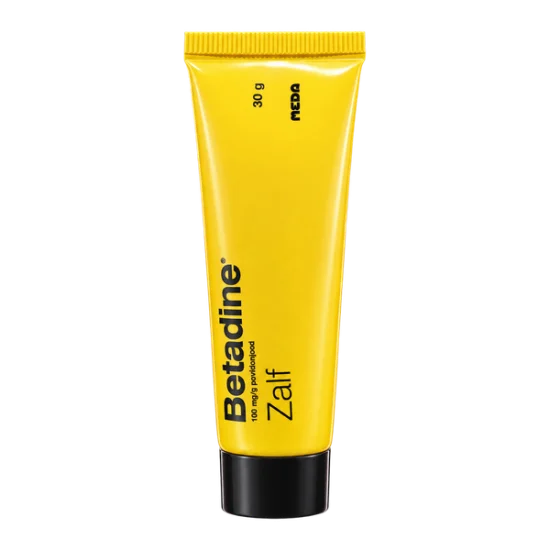
Betadine is an ointment supplied in a tube for external application to the skin. It is intended for local antiseptic care of small cuts, grazes, abrasions, and limited superficial burns. Apply a thin layer to clean, dry skin; the exact regimen for the chosen strength should be confirmed with a healthcare professional before starting.

Dosage and administration

Apply Betadine to clean, dry skin as a thin layer over the affected area. Wash your hands before application and again afterwards, unless the hands themselves are the treated area.

For a minor injury:

  • Remove visible dirt with clean water.
  • Pat the surrounding skin dry.
  • Apply a thin layer of Betadine ointment.
  • Cover the area with a clean dressing if friction or contamination is likely.
  • Replace the dressing when it becomes wet or dirty.
  • Stop and seek clinical assessment if the wound becomes more painful, swollen, hot, or increasingly red.

Do not rub the ointment aggressively into damaged tissue. Gentle application reduces irritation and avoids disturbing a developing scab.

If the wound is on a finger, leave enough flexibility for movement and avoid wrapping a dressing so tightly that the fingertip becomes pale, cold, numb, or blue.

Betadine is intended for external use. Avoid contact with the eyes and do not apply it inside the mouth or to internal body surfaces. A wound caused by an animal or human bite, a deep puncture, a large burn, or a heavily contaminated object needs medical assessment rather than repeated self-treatment.

Missed or repeated application

A missed application does not require extra ointment at the next opportunity. Resume the usual local-care routine with a thin layer.

Repeated application over a large area can increase exposure to iodine-containing antiseptic material. The MHRA advises care with topical iodine preparations in people with thyroid disease, kidney impairment, or prolonged exposure needs [2].

Comparison

Betadine belongs to the topical antiseptic category. Other wound-care approaches focus on rinsing, physical protection, moisture control, or specialist treatment rather than adding an antiseptic.

Approach Main role Practical limitation
Betadine ointment Local antiseptic care for minor superficial skin injuries Not suitable for deep, extensive, or infected wounds without assessment
Clean water and a dressing Removes debris and protects the wound May be insufficient when antiseptic treatment is specifically indicated
Specialist wound treatment Manages deep, complex, chronic, or infected wounds Requires clinical assessment and an individual care plan

The choice depends on the injury, its depth, contamination, location, and the person’s medical history. An antiseptic does not accelerate every wound, and repeated application can irritate sensitive skin.

Seek prompt medical attention when bleeding does not stop with firm pressure, the wound edges gape, sensation or movement is reduced, or a foreign object remains embedded.

Common mistakes

  • Applying ointment to visible dirt without first rinsing the wound.
  • Using a thick layer that remains wet beneath a tight dressing.
  • Reapplying frequently because the wound still looks pink.
  • Using Betadine on a deep puncture or bite instead of obtaining medical assessment.
  • Applying it close to the eye or allowing it to run into the eye.
  • Combining several antiseptic creams on the same site.
  • Continuing treatment despite a spreading rash or increasing burning.
  • Sharing the tube between several people.
  • Treating a chronic ulcer as if it were a new minor graze.
  • Ignoring loss of movement, numbness, persistent bleeding, or fever.

An antiseptic ointment should not be used to delay assessment when infection is suspected. A small wound that steadily worsens needs a different clinical plan.

What doctors say

In clinical practice, a doctor first assesses the wound rather than choosing an antiseptic by name. Size, depth, contamination, bleeding, location, vaccination status, and signs of infection determine the appropriate plan.

For a small superficial injury, the usual priorities are cleaning, a thin topical layer when indicated, and protection from further friction. A doctor would not expect an ointment to treat a deep abscess, cellulitis, a retained splinter, or tissue damage extending beneath the surface.

The British National Formulary describes topical antiseptics as products that require attention to site, duration, sensitivity, and systemic absorption risk [4]. This is why short-term use on a small area differs from prolonged treatment of a large wound.

Patients often judge a wound by colour alone. Mild pinkness around a fresh abrasion can be part of normal healing, while expanding redness, warmth, swelling, pus, worsening pain, or fever suggests a problem needing assessment.

Questions and answers

Does Betadine cause skin staining or irritation?

Betadine may leave a yellow-brown colour on the skin or dressing because iodine-containing topical preparations can stain materials. Mild stinging, dryness, itching, or redness may occur after application, especially on sensitive or broken skin. The EMA identifies local reactions and thyroid-related precautions among the points considered for topical iodine preparations in its 2022 product information. The colour itself does not show whether healing is complete. Stop use if irritation spreads, becomes severe, or is accompanied by swelling or blistering.

Can Betadine affect driving, concentration, or work with machinery?

A small amount applied to a minor skin injury is not expected to impair alertness, concentration, driving, or operation of machinery. The main concern is local discomfort, an allergic reaction, or symptoms caused by the injury itself rather than a sedative effect. MHRA medicine-safety principles published in 2023 support attention to patient symptoms and reactions when using topical preparations. Do not drive if you develop dizziness, breathing difficulty, faintness, or another symptom that affects safe control.

How long does one application of Betadine keep working?

A single application provides local antiseptic contact while the ointment remains on the treated skin. Washing, sweating, friction, discharge, or a wet dressing can remove it and may require renewed wound care. WHO wound-care guidance published in 2018 supports reassessing the wound and dressing rather than applying topical products indefinitely. The required duration depends on the injury and should not be extended simply because the skin remains discoloured.

How should Betadine be applied to the wound?

Wash your hands, rinse away visible dirt, and gently dry the surrounding skin. Apply a thin layer over the superficial injured area without vigorous rubbing. Wash your hands after application and cover the site with a clean dressing if clothing or dirt will rub against it. A clinician should assess large, deep, heavily contaminated, or persistently bleeding wounds; the MHRA advises caution with extensive topical exposure in its 2023 guidance.

Can Betadine be used with other medicines or supplements?

Do not apply Betadine to the same area at the same time as another antiseptic or medicated cream unless a clinician has directed this combination. People taking lithium or medicines that influence thyroid function should seek specific advice before repeated or extensive use. The EMA’s 2022 product information for iodine-containing preparations addresses absorption and thyroid precautions. Ordinary oral vitamins do not automatically make a small, short-term skin application unsuitable, but a full medicines review is needed when prolonged treatment is planned.

Can Betadine be used during pregnancy or breastfeeding?

Pregnancy and breastfeeding require particular care with repeated or large-area application because iodine can be absorbed through damaged skin. Avoid applying the ointment to the breast before feeding, and wash the area thoroughly before the infant feeds if breast application has been clinically directed. WHO guidance published in 2018 supports individual assessment when topical products are used during pregnancy or lactation. A small isolated application should still be discussed with a healthcare professional when pregnancy, breastfeeding, thyroid disease, or extensive skin damage is involved.

What should be discussed with a doctor before starting Betadine?

Discuss any iodine sensitivity, thyroid disorder, kidney disease, lithium treatment, planned radioactive iodine procedure, pregnancy, or breastfeeding. Mention if the wound is deep, infected-looking, caused by a bite, or located near the eye. The BNF 2025 describes site, duration, and systemic absorption as important considerations for topical antiseptics. Also discuss the need for wound closure, tetanus assessment, or treatment beyond an ointment when the injury is not a minor superficial wound.

Do you offer anonymous delivery?

Your order will be securely packed and shipped within 24 hours. This is exactly what your package will look like (images of an actual item sent). It has the size and look of a regular private letter (24x11x0.7 cm) and its contents cannot be seen.

Comparison

Comparison table: Antiseptics

Betadine: What Customers Say

3.6
Based on 4 reviews
Claire, 44 Aberdeen Several days
Verified
Rating: 3 out of 5

The ointment stayed in place better than a watery solution. It tingled briefly, and the yellow-brown colour marked the dressing, so I changed it more often.

1 Oct 2026
Julie, 56 Sunderland
Verified
Rating: 5 out of 5

The cut was superficial and settled after cleaning and covering it. I found the tube easy to use, although the skin around the cut became dry when I applied it too frequently.

11 Oct 2026
Fiona H., 39 Cardiff
Verified
Rating: 3.5 out of 5

It was convenient for a small scraped knee, and I had no trouble with the wound. I stopped after the skin became itchy at the edge, and the irritation eased.

17 Oct 2026
Kerry D., 33 Middlesbrough
Verified
Rating: 3 out of 5

The ointment was simple to spread and did not run. I expected the redness to disappear immediately, but the skin still looked pink for a few days while healing.

28 Oct 2026

Sources

  1. World Health Organization (2018). Basic emergency care: approach to the acutely ill and injured.
  2. Medicines and Healthcare products Regulatory Agency (2023). Betadine Antiseptic Ointment: Summary of Product Characteristics (SmPC).
  3. European Medicines Agency (2022). Summary of Product Characteristics (SmPC) — povidone-iodine topical preparations.
  4. British National Formulary (2025). Topical antiseptics — povidone-iodine.
Get our free app Shop faster and track your orders Install