The solution was easy to apply and dried without leaving much residue. I noticed mild stinging on one scraped area, so I avoided putting it there again.
Chlorhexidine
The solution is intended for external application only and is used on the skin rather than taken by mouth. Its antiseptic action helps reduce surface bacteria by disrupting bacterial membranes.
About this product
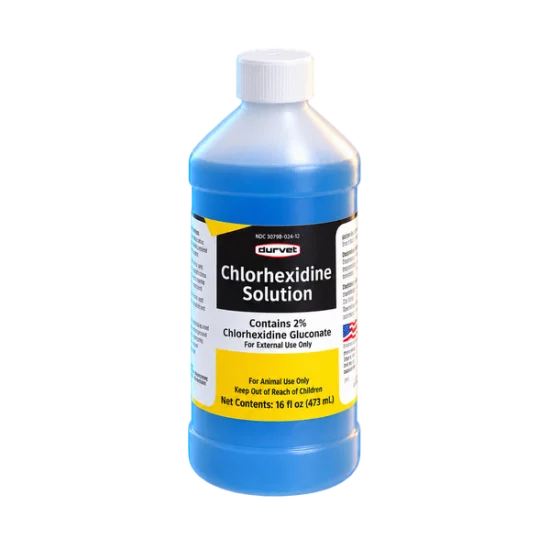
Chlorhexidine is supplied as an external-use solution in a bottle and applied to the skin rather than taken by mouth. It contains 2% chlorhexidine gluconate for antiseptic cleansing and reduction of surface bacteria.
Uses
A 2% chlorhexidine solution may be used for antiseptic skin cleansing when an external skin preparation is required.
Reducing surface bacteria can support infection-control goals.
Pharmacological action
Chlorhexidine acts at the bacterial cell envelope. At lower exposure levels, it can interfere with membrane function and inhibit bacterial growth. At higher local exposure, it causes leakage of intracellular material and bacterial cell death.
Its activity includes many Gram-positive bacteria and several Gram-negative bacteria. The effect is strongest against susceptible bacteria on the treated surface. Chlorhexidine is not a universal treatment for every virus, fungus, spore, or resistant organism.
A useful feature is residual binding. Chlorhexidine can attach to skin proteins and remain active on the surface after application, which is known as substantivity. This property helps maintain antiseptic activity between applications, although washing, rubbing, organic material, and repeated contact can reduce the effect.
Laboratory work has shown activity against organisms such as Escherichia coli and Salmonella. Laboratory inactivation does not guarantee elimination of every organism in a clinical setting, because concentration, contact time, surface condition, and organic contamination all influence the result. The World Health Organization discusses these practical factors in infection-prevention protocols [1], while NICE publishes site-specific guidance for wound and infection management.
Antimicrobial coverage
Chlorhexidine gluconate may act against:
- Many Gram-positive bacteria.
- Several Gram-negative bacteria, including susceptible Escherichia coli and Salmonella.
- Some yeasts and enveloped viruses, depending on concentration and exposure conditions.
- Surface bacteria that remain after ordinary washing.
Chlorhexidine does not replace targeted antifungal treatment such as nystatin when a confirmed fungal infection requires that therapy. It also does not sterilise a surface or destroy bacterial spores reliably.
When not to use it
- Known allergy to chlorhexidine or a previous unexplained reaction after an antiseptic procedure.
- Extensive burns or large areas of damaged skin.
- Neonatal skin, where immature skin can absorb topical substances more readily.
- Severe eczema or active dermatitis.
- Application near the eyes, ears, mouth, or genital mucosa.
- Use beneath occlusive dressings or equipment that can trap liquid.
- Concurrent use of another topical antiseptic on the same area.
Chlorhexidine is also unsuitable for application to the eyes, middle ear, meninges, brain, joints, or deep body cavities.
When this is not for you
Chlorhexidine is not suitable for you if you have previously experienced a reaction to chlorhexidine or chlorhexidine gluconate. Do not use it on your eyes, ears, mouth, deep wounds, joints, or inside body cavities. Extra caution is needed on extensive burns, large areas of damaged skin, neonatal skin, severe eczema, or active dermatitis. Avoid using it beneath dressings or equipment that can trap liquid, and do not combine it with another antiseptic on the same area unless a clinician has instructed you to do so.
Adverse reactions
Most application-related problems are local. Burning, stinging, dryness, redness, itching, or irritation may occur, especially on damaged or sensitive skin. Repeated application over a large surface can increase local exposure and discomfort.
Possible adverse effects include:
- Irritant contact dermatitis.
- Allergic contact dermatitis.
- Local redness, swelling, or blistering.
- Eye injury after accidental exposure.
- Chemical injury to sensitive tissues.
- Rare immediate hypersensitivity reactions, including anaphylaxis.
Chlorhexidine has been associated with serious allergic reactions, including anaphylactic reactions. The MHRA has issued safety communications about chlorhexidine hypersensitivity, and a previous reaction to chlorhexidine is a strong reason to avoid re-exposure [3].
Anaphylaxis may involve rapidly developing facial or throat swelling, wheezing, breathing difficulty, faintness, widespread hives, or sudden collapse. This requires emergency treatment. Local redness alone is more often irritation, yet rapidly spreading swelling or breathing symptoms should never be ignored.
Chondrolysis is a specialised complication associated with exposure of cartilage to certain antiseptic irrigation practices, especially in joint spaces. It is not a normal skin effect and reinforces the rule that external chlorhexidine must not be introduced into joints or other enclosed body spaces.
Patients with eczema or broken skin may experience more stinging. The solution should not be applied beneath soaked dressings or allowed to pool, because prolonged contact can intensify irritation.

What it contains
Chlorhexidine is a bisbiguanide antiseptic. The active substance in this product is chlorhexidine gluconate at a concentration of 2%. The bottle contains an external-use solution.
The amount and frequency vary with the strength, treatment area, clinical purpose, skin condition, and user, so no single amount suits everyone.
Chlorhexidine gluconate is a water-soluble salt that releases chlorhexidine at the skin surface. The molecule carries a positive charge, allowing it to bind to negatively charged bacterial cell walls and membranes. This interaction disrupts membrane integrity and reduces microbial survival.
Other chlorhexidine salts, including chlorhexidine acetate and chlorhexidine diphosphanilate, exist in pharmaceutical research and selected formulations. Their presence does not change the identity of this product, which is a 2% chlorhexidine gluconate solution.
The pharmacological class is topical antiseptic. It is used to reduce microorganisms on external skin surfaces.
Dosage and administration
This product is intended for external use. A 2% chlorhexidine solution may be used for antiseptic skin cleansing when an external skin preparation is required. The exact amount and frequency depend on the treatment area, clinical purpose, skin condition, and the healthcare protocol being followed; there is no single amount that suits everyone.
Chlorhexidine should not be poured into deep wounds, body cavities, joints, or enclosed spaces. Contact with the brain, meninges, middle ear, eyes, or delicate internal tissues can cause serious injury. A solution designed for external skin use should not be substituted for a sterile irrigation solution.
Practical application principles
- Use the solution on intact external skin or the area specified by the clinical protocol.
- Avoid contact with eyes and mucous membranes.
- Prevent pooling under a patient, in skin folds, or beneath occlusive equipment.
- Allow the treated area to dry when the protocol requires drying.
- Do not mix chlorhexidine with other antiseptics unless a clinician has specifically selected the combination.
- Keep the solution away from heat, flames, and electrical equipment until the skin and surrounding area are dry.
Comparison
Chlorhexidine, povidone-iodine, and polyhexamethylene biguanide have different chemical properties. The choice depends on the body site, the intended contact time, the presence of organic material, the patient’s allergy history, and tissue sensitivity.
| Antiseptic | Main clinical feature | Main limitation |
|---|---|---|
| Chlorhexidine gluconate | Persistent surface binding and broad activity against many bacteria | Can cause irritation or serious hypersensitivity; unsuitable for eyes, ears, brain, joints, and some wounds |
| Povidone-iodine | Broad activity across bacteria, fungi, viruses, and some spores | Less persistent binding; iodine exposure may matter in thyroid disease or selected sensitive patients |
| Polyhexamethylene biguanide | Used in selected wound and surface-cleansing products | Formulation and indication vary; evidence differs by product and clinical setting |
Povidone-iodine may be selected when a wider organism range is required, while chlorhexidine may be preferred when persistent skin activity is useful. Some clinical studies have associated povidone-iodine with superior outcomes in specific procedures, while other protocols favour chlorhexidine for skin preparation. The result depends on the operation, product concentration, preparation technique, and comparator.
The European Medicines Agency evaluates antiseptic safety through product-specific regulatory documentation rather than treating all concentrations as interchangeable. A 2% external solution should therefore be used for its stated route and purpose, not as a substitute for a lower-concentration wound irrigant or an oral formulation [2].
Common mistakes
Several practical errors reduce the benefit or increase the risk of chlorhexidine:
- Applying an external solution inside the mouth or on the tongue.
- Using it in the eye or ear because the area appears infected.
- Pouring it into a deep wound or joint.
- Mixing it with povidone-iodine, detergents, or another antiseptic without a compatibility instruction.
- Covering wet skin immediately with an occlusive material.
- Reapplying repeatedly to compensate for a missed application.
- Continuing after widespread itching, blistering, facial swelling, or breathing symptoms.
- Assuming that a strong antiseptic can treat every type of microorganism.
- Using it on a child or newborn without site-specific clinical direction.
- Applying it over a large area when only a small treatment field was intended.
A further mistake is using chlorhexidine to clean equipment or surfaces when the product is intended for skin. Product-specific concentration and contact requirements matter for environmental disinfection.
What doctors say
Clinicians usually view chlorhexidine as a targeted surface antiseptic, not as a general treatment for infection. Its usefulness comes from local microbial reduction and surface persistence. It reduces surface microbial load without treating tissue invasion. It does not replace antibiotics when bacteria have invaded tissue, and it does not treat an established abscess, cellulitis, or systemic infection. Site and tissue condition determine whether it is appropriate.
A doctor will usually assess the site before recommending repeated application. The same antiseptic can be reasonable for intact skin and inappropriate for a deep wound, eye area, ear, or joint. Concentration matters.
The FDA has also highlighted serious allergic reactions linked with chlorhexidine-containing products. This means allergy history should be taken before planned exposure, especially during procedures where the patient may be exposed over a large area [4].
In practice, clinicians also watch for wet pooling. A liquid antiseptic trapped beneath a patient, tourniquet, pad, or adhesive device can produce prolonged contact and skin injury even when the initial application seemed uneventful.
Questions and answers
Does Chlorhexidine cause skin staining?
Temporary redness, dryness, or irritation can occur after topical application, and persistent staining is less typical than with some oral chlorhexidine preparations. Dental staining is linked with chlorhexidine mouthwash, not with correctly applied external skin use. MHRA safety information from 2014 focuses on hypersensitivity reactions rather than routine permanent staining, so sudden swelling or breathing difficulty requires emergency attention.
What should I do if the expected result does not come?
Do not increase the amount or frequency automatically when the skin problem does not improve. Chlorhexidine reduces surface microorganisms but does not treat every cause of redness, pain, discharge, or swelling. Guidance from the WHO in 2016 supports reassessing the site and the clinical purpose when antiseptic cleansing is not producing the expected response.
How does Chlorhexidine differ from povidone-iodine?
Chlorhexidine gluconate binds to skin and can provide persistent surface activity, while povidone-iodine has a broad oxidising antimicrobial action with less residual binding. Neither agent is suitable for every body site or wound type. The EMA’s 2020 product information illustrates that formulation, concentration, route, and exposure site should guide selection rather than the product name alone.
What should I do after a missed application?
Apply the next planned application when appropriate rather than using a heavy layer to compensate. A missed topical application usually does not justify doubling the amount, since prolonged wet contact can increase irritation. MHRA advice from 2014 also supports stopping exposure and seeking urgent help when symptoms suggest a serious allergic reaction.
Can people under 18 use Chlorhexidine?
Use in children depends on the treatment site, age, skin condition, and the specific clinical instruction. Extra caution is needed for newborns, premature infants, and children with damaged or extensive skin because absorption and irritation may be greater. WHO infection-prevention guidance from 2016 supports age-appropriate antiseptic selection and careful avoidance of eyes, mucosa, and enclosed body spaces.
Does Chlorhexidine affect driving, concentration, or machinery work?
A correctly used external solution does not usually cause drowsiness or impair concentration because it is not intended to act through the brain. Driving may be affected indirectly if an allergic reaction, severe irritation, dizziness, or eye exposure occurs. The MHRA’s 2014 chlorhexidine warning makes clear that breathing symptoms or rapid swelling require emergency care rather than continued work or driving.
How long does a course last, and is long-term use acceptable?
There is no single course length for every external skin application, because duration depends on the clinical purpose and treatment site. Repeated long-term use can cause dryness, irritation, or contact dermatitis and may be unnecessary once the intended antiseptic task is complete. WHO guidance from 2016 supports using antiseptics for a defined clinical purpose and reviewing continued exposure when the skin remains irritated.
Do you offer anonymous delivery?
Your order will be securely packed and shipped within 24 hours. This is exactly what your package will look like (images of an actual item sent). It has the size and look of a regular private letter (24x11x0.7 cm) and its contents cannot be seen.
Comparison
Comparison table: AntisepticsChlorhexidine: What Customers Say
The skin felt clean afterwards and the bottle lasted longer than expected. The smell was stronger than I expected, and I had some dryness around the treated area.
It was convenient to keep in the bathroom and I had no trouble on intact skin. I stopped using it when redness appeared after repeated applications and the redness settled.
The application itself was straightforward, but I accidentally let some run near my eye and needed to rinse promptly. I would be much more careful about the treatment area now.
Sources
- World Health Organization (2016). Global Guidelines for the Prevention of Surgical Site Infection
- European Medicines Agency (2020). Summary of Product Characteristics (SmPC) — chlorhexidine gluconate
- Medicines and Healthcare products Regulatory Agency (2014). Chlorhexidine: reminder of the risk of serious allergic reactions
- U.S. Food and Drug Administration (2017). FDA Drug Safety Communication: FDA warns about rare but serious allergic reactions with chlorhexidine gluconate antiseptics