Skip to content
Save up to 80%
Augmentin
Active ingredient: Amoxicillin

Augmentin

Quality products
24/7 Support
Fast delivery
Delivery from 4 days
Select pack Package Per tablet Price

Free delivery on orders from £ 200.00, free express delivery from £ 300.00

Secure Payments
Track your order
Best price guarantee

Augmentin is a penicillin antibiotic combined with a beta-lactamase inhibitor. It is prescribed for selected susceptible bacterial infections, with clavulanate helping protect amoxicillin from enzymatic breakdown.

About this product

Amoxicillin with clavulanate potassium, the active combination in Augmentin, is a penicillin antibiotic paired with a beta-lactamase inhibitor.

Uses

Augmentin is prescribed for selected bacterial infections when the likely organisms are susceptible. The exact diagnosis matters because similar symptoms can come from viruses, allergies, inflammation, or other causes.

Common clinical uses include:

  • bacterial sinus infections;
  • middle-ear infections;
  • lower respiratory infections, including some cases of bacterial pneumonia;
  • urinary tract infections;
  • skin and soft-tissue infections;
  • dental infections and acute dental abscesses;
  • selected bone and joint infections;
  • some animal-bite infections, when the clinical assessment supports this choice.

Augmentin does not treat viral infections such as ordinary colds, influenza, or most uncomplicated sore throats. Using it for a viral illness exposes the person to adverse effects without treating the cause and can contribute to antibiotic resistance. The WHO classifies amoxicillin with clavulanic acid among antibiotics requiring careful, indication-based use [1].

More likely to respond Usually does not respond
Susceptible bacterial sinus, ear, urinary, skin, respiratory, or dental infection Common cold or influenza
Bacterial pneumonia confirmed or strongly suspected by a clinician Viral cough or viral bronchitis
Susceptible acute apical dental abscess Symptoms caused by allergy or irritation

A dental abscess may require drainage or another dental procedure as well as an antibiotic. Antibiotics alone may not remove the source of infection. Worsening facial swelling, difficulty swallowing, or breathing difficulty requires urgent medical assessment.

Pharmacological action

Role of amoxicillin

Amoxicillin binds to bacterial penicillin-binding proteins. This blocks enzymes needed to build and repair the bacterial cell wall. The weakened wall can rupture as the bacterium grows, which leads to bacterial death.

Amoxicillin acts against susceptible organisms, but some bacteria produce beta-lactamase. These enzymes can inactivate certain penicillin antibiotics before they reach their target.

Role of clavulanic acid

Clavulanic acid, supplied as clavulanate potassium, binds to several beta-lactamase enzymes and reduces their ability to degrade amoxicillin. This extends the antibacterial activity of the combination against susceptible beta-lactamase-producing organisms.

Clavulanate does not make Augmentin suitable for every infection. Bacterial susceptibility, infection site, resistance patterns, kidney function, and the selected regimen still determine whether treatment is appropriate.

When not to use it

Augmentin is not suitable for everyone.

  • you previously experienced anaphylaxis, angioedema, or another serious immediate reaction to penicillin or another beta-lactam antibiotic;
  • you previously developed jaundice or liver impairment specifically associated with amoxicillin/clavulanate;
  • the current illness is viral and there is no diagnosed or strongly suspected bacterial infection;
  • the prescriber has identified a bacterial organism resistant to the combination;
  • severe kidney impairment makes the 625 mg tablet regimen unsuitable.

When this is not for you

A history of a mild rash with an antibiotic needs careful clinical interpretation. A blistering rash, mucosal sores, facial swelling, breathing difficulty, or rapid onset after a dose suggests a more serious reaction and must be treated as an urgent warning.

Liver disease, previous antibiotic-associated colitis, glandular fever, and significant kidney disease also affect treatment decisions. People with infectious mononucleosis have a higher risk of developing a rash with aminopenicillin antibiotics, so Augmentin may be unsuitable when that diagnosis is suspected.

Pregnancy and breastfeeding require an individual assessment of the infection and the treatment choice. Amoxicillin/clavulanate is used in some pregnancies when clinically indicated, but the prescriber must weigh the expected benefit against the clinical circumstances.

Adverse reactions

The most frequent problems involve the digestive system. Diarrhoea, nausea, vomiting, indigestion, and abdominal discomfort can occur with amoxicillin/clavulanate potassium. Taking the tablet with food may make nausea easier to tolerate.

Mild loose stools can occur during treatment. Severe, persistent, or bloody diarrhoea is different and can indicate antibiotic-associated colitis, including Clostridioides difficile infection. It can occur during treatment or after the course has ended.

Other possible reactions include:

  • headache;
  • dizziness;
  • skin rash;
  • itching;
  • urticaria, also called hives;
  • oral or vaginal thrush;
  • temporary changes in liver blood tests.

Serious reactions requiring urgent action

Stop taking further doses and obtain urgent medical help for swelling of the lips, tongue, face, or throat; wheezing; breathing difficulty; faintness; or rapidly spreading hives. These may indicate a serious hypersensitivity reaction.

Seek prompt medical assessment for yellowing of the skin or eyes, unusually dark urine, pale stools, severe itching, or significant pain beneath the right ribs. These symptoms may indicate liver injury or impaired bile flow. Augmentin-associated liver reactions can appear during treatment or after the final tablet.

A widespread blistering rash, skin peeling, sores in the mouth, or painful red skin requires emergency assessment. Such findings can indicate a severe cutaneous adverse reaction.

Diarrhoea that is severe, persistent, bloody, or accompanied by abdominal cramping should not be treated with an over-the-counter anti-diarrhoeal product without medical advice.

What it contains

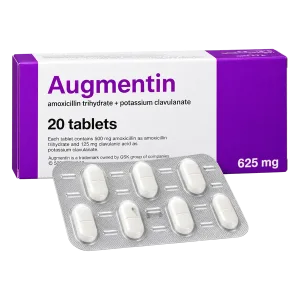
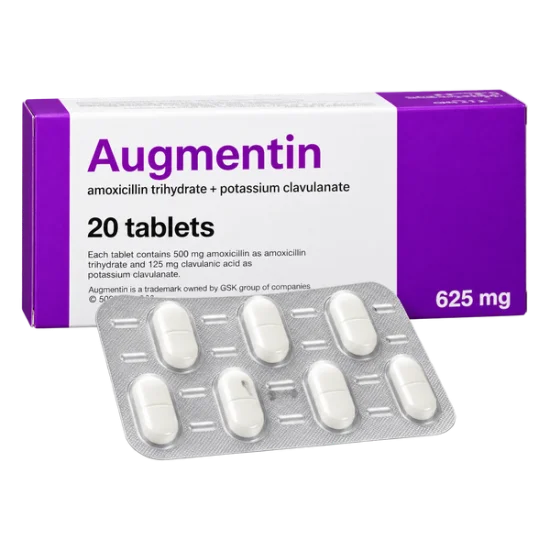
Augmentin contains amoxicillin trihydrate and potassium clavulanate. The tablet formulation is supplied as an oral tablet in a 20-tablet pack. Amoxicillin belongs to the penicillin class, while clavulanate is a beta-lactamase inhibitor rather than an antibiotic used alone.

The combination is called amoxicillin/clavulanate potassium or amoxicillin/clavulanic acid. Its purpose is to treat bacteria that may produce beta-lactamase enzymes capable of breaking down amoxicillin. The regimen for the chosen strength should be confirmed with a healthcare professional before starting. The FDA prescribing information describes this paired action in the clinical pharmacology of Augmentin [1].

Dosage and administration

The product described on this page is Augmentin in tablet form. Tablets are intended for oral administration and should be swallowed with water. The regimen for the chosen strength must be confirmed with a healthcare professional before starting, because dose selection depends on the infection, renal function, age, body weight, and local prescribing guidance.

Augmentin is taken by mouth, with the first mouthful of food, at the intervals selected for the diagnosed infection and kidney function.

Practical administration points include:

  • take each dose at the prescribed interval;
  • swallow the tablet with water;
  • complete the prescribed course unless the prescriber changes it;
  • if a dose is missed, take it when remembered unless the next dose is close;
  • do not take two doses together to compensate for a missed dose;
  • keep doses evenly spaced rather than taking them close together;
  • do not share tablets with another person who has similar symptoms.

Treatment duration varies. A short course may be appropriate for one infection, while a different duration may be selected for a deeper or recurrent infection. NICE antimicrobial guidance links antibiotic choice and duration to the infection site, severity, and clinical response [2].

One common mistake is stopping as soon as fever or pain improves. Symptoms can settle before the bacterial infection has been adequately treated. Another is taking two tablets together after forgetting a dose, which increases the chance of nausea, diarrhoea, and other adverse effects.

Take Augmentin with the first mouthful of a meal. This timing can improve clavulanate absorption and may reduce stomach upset.
Do not crush or chew an Augmentin tablet unless a prescriber or pharmacist has confirmed that the specific tablet can be altered. Swallowing it whole helps deliver the intended dose.

Comparison

Augmentin is an oral combination antibiotic: amoxicillin provides the penicillin component, while clavulanate inhibits beta-lactamase enzymes. This differs from a single-ingredient antibiotic because it combines antibacterial treatment with enzyme inhibition.

Common mistakes

Several avoidable habits can reduce the benefit of treatment or increase adverse effects:

  • taking tablets on an empty stomach when nausea is already a problem;
  • taking doses at irregular times;
  • doubling the next dose after a missed tablet;
  • stopping early because symptoms improved;
  • using leftover tablets for a new illness;
  • sharing tablets with a family member;
  • ignoring a new rash;
  • treating severe diarrhoea with anti-diarrhoeal medicine without assessment;
  • failing to mention warfarin, allopurinol, probenecid, or methotrexate;
  • assuming a dental abscess will resolve without dental treatment;
  • crushing tablets without confirming that alteration is appropriate.
Keep a simple written record of each dose if the course is difficult to remember. This reduces accidental double dosing and helps explain missed doses accurately.

What doctors say

In clinical practice, prescribers usually select Augmentin when bacterial coverage is needed and amoxicillin alone may not adequately address beta-lactamase-producing organisms. The combination is not automatically the best choice for every respiratory, urinary, or dental symptom.

A doctor will usually consider:

  • the likely infection site;
  • symptom severity and duration;
  • previous antibiotic exposure;
  • allergy history;
  • kidney and liver function;
  • local resistance information;
  • culture or susceptibility results when available.

The 625 mg tablet should not be selected by matching the number to body size alone. The amoxicillin-to-clavulanate ratio, dosing interval, and treatment duration all matter. More antibiotic is not necessarily better; excessive clavulanate can increase gastrointestinal adverse effects without improving treatment of a non-susceptible organism.

A practical prescribing point is the difference between expected early improvement and treatment failure. Persistent fever, worsening pain, new swelling, or deterioration after treatment begins may indicate resistance, an abscess requiring drainage, an incorrect diagnosis, or a complication.

Questions and answers

Can alcohol be consumed while taking Augmentin?

The NHS and MHRA do not describe a specific alcohol reaction comparable to the interaction seen with some other antibiotics. Even so, alcohol can worsen nausea, dizziness, dehydration, and diarrhoea while the infection itself is causing illness. Avoiding alcohol during the course is a sensible way to reduce those overlapping effects, especially when symptoms are significant. The Augmentin prescribing information reviewed by the FDA in 2023 does not list alcohol as a direct contraindication. A pharmacist can help assess alcohol use when symptoms or adverse effects are present.

How does Augmentin differ from amoxicillin alone?

Augmentin combines amoxicillin with clavulanate potassium, while amoxicillin alone contains only the penicillin antibiotic. Clavulanate inhibits several beta-lactamase enzymes, allowing amoxicillin to remain active against certain susceptible bacteria that could otherwise inactivate it. The combination also causes more gastrointestinal adverse effects in some patients, so broader coverage does not make it preferable for every infection. The FDA Augmentin prescribing information from 2023 describes beta-lactamase inhibition as the key pharmacological difference.

Should Augmentin be taken with food or on an empty stomach?

Augmentin tablets should be taken with the first mouthful of a meal. Food can improve absorption of clavulanate and may reduce nausea or stomach discomfort. Taking the tablet after finishing a meal is less closely aligned with the recommended timing than taking it at the beginning. NICE guidance on acute cough and antimicrobial prescribing supports administration with food for co-amoxiclav formulations.

Does Augmentin cause diarrhoea?

Yes, diarrhoea is a recognised adverse effect of Augmentin because antibiotics can alter the normal intestinal bacterial balance. Mild loose stools may settle during or shortly after treatment, especially when the tablets are taken with food and adequate fluids are maintained. Severe, watery, persistent, or bloody diarrhoea needs prompt medical assessment because Clostridioides difficile colitis can occur during or after antibiotic exposure. MHRA safety information identifies significant antibiotic-associated diarrhoea as a clinical warning rather than a routine nuisance symptom.

What should be discussed with a doctor before starting Augmentin?

Before starting, discuss any penicillin or cephalosporin allergy, previous liver problems after antibiotics, kidney disease, inflammatory bowel disease, pregnancy, and breastfeeding. Provide a complete list of medicines, especially warfarin, allopurinol, probenecid, methotrexate, and mycophenolate. The prescriber should confirm that the 625 mg tablet regimen fits the diagnosed infection and renal function. WHO antimicrobial stewardship guidance supports choosing an antibiotic only when the likely bacterial cause and treatment plan have been assessed [3].

Do you offer anonymous delivery?

Your order will be securely packed and shipped within 24 hours. This is exactly what your package will look like (images of an actual item sent). It has the size and look of a regular private letter (24x11x0.7 cm) and its contents cannot be seen.

Comparison

Comparison table: Antibiotics

Augmentin: What Customers Say

3.2
Based on 3 reviews
Steven, 48 Belfast Five days
Verified
Rating: 3 out of 5

I took the tablets with breakfast and dinner as prescribed for a dental infection. The pain began easing after a couple of days, but I still needed the dental appointment. I had softer stools, though nothing severe.

28 Oct 2026
Susan, 40 Derby One week
Verified
Rating: 3 out of 5

The sinus symptoms improved, but the first two days brought nausea and a strange taste. Taking each tablet with food helped. I developed itching near the end of the course, so I stopped and contacted the surgery rather than taking another dose.

1 Oct 2026
Oliver, 36 Wolverhampton Seven days
Verified
Rating: 3.5 out of 5

The chest infection settled gradually rather than overnight. I missed one tablet during a work shift and took the next dose at the normal time instead of doubling it. Diarrhoea continued for several days afterwards, so I reported it.

16 Oct 2026

Sources

  1. U.S. Food and Drug Administration (2023). AUGMENTIN (amoxicillin and clavulanate potassium) Prescribing Information.
  2. National Institute for Health and Care Excellence (2018). Cough (acute): antimicrobial prescribing (NG120).
  3. World Health Organization (2022). The WHO AWaRe Antibiotic Book: Antibiotic Treatment Guidance for Common Infections.
Get our free app Shop faster and track your orders Install